
Air Filter Housing Sealing: Why a Correct Element Still Lets Dust Through
A perfectly specified element cannot protect an airend if the housing leaks. Where dust bypass happens, how to test for it, and the end-cap profiles that actually hold a seal under vibration.

When silica shows up in an oil analysis, the first suspect is usually the filter media. In the field, the more common cause is dust that never went through the media at all. A housing that leaks at the cover, at the end cap or at the outlet neck will pass abrasive particles straight into the airend while the restriction indicator still reads normal.
The three usual bypass paths
The first is the service cover: a distorted lid, a perished rubber gasket, or clips tightened unevenly leave a gap that opens further under inlet pulsation. The second is the element end cap: an iron cap, PU moulding or rubber lip that is 1–2 mm short of the seat looks seated but does not compress. The third is the outlet connection between the housing and the intake hose, where a loose clamp on the clean side is especially damaging because it draws unfiltered plant air directly into the compressor.
Why vibration makes it worse
Screw and piston compressors generate continuous low-frequency vibration. A heavy element supported only by its end cap acts as a cantilever; over hundreds of hours it frets the sealing face, ovalises the seat and works the clamp loose. This is why desert and mobile installations use two-stage assemblies with a pre-cleaner and a safety element, and why the correct replacement part has to match the original end-cap stiffness, not just its diameter.
How to check for a leak in ten minutes
- Wipe the clean side of the housing and the outlet neck until no dust is visible.
- Run the compressor at full load for a short cycle with a clean element fitted.
- Inspect with a bright light and a white cloth: any dust trail on the clean side is a leak path, not media penetration.
- Check that the restriction indicator drops to zero at rest and rises smoothly under load; an erratic reading often means a loose connection.
- On critical machines, use a low-pressure smoke test on the clean side while the machine is stopped.
Specifying the replacement correctly
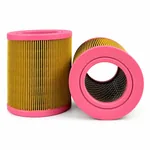
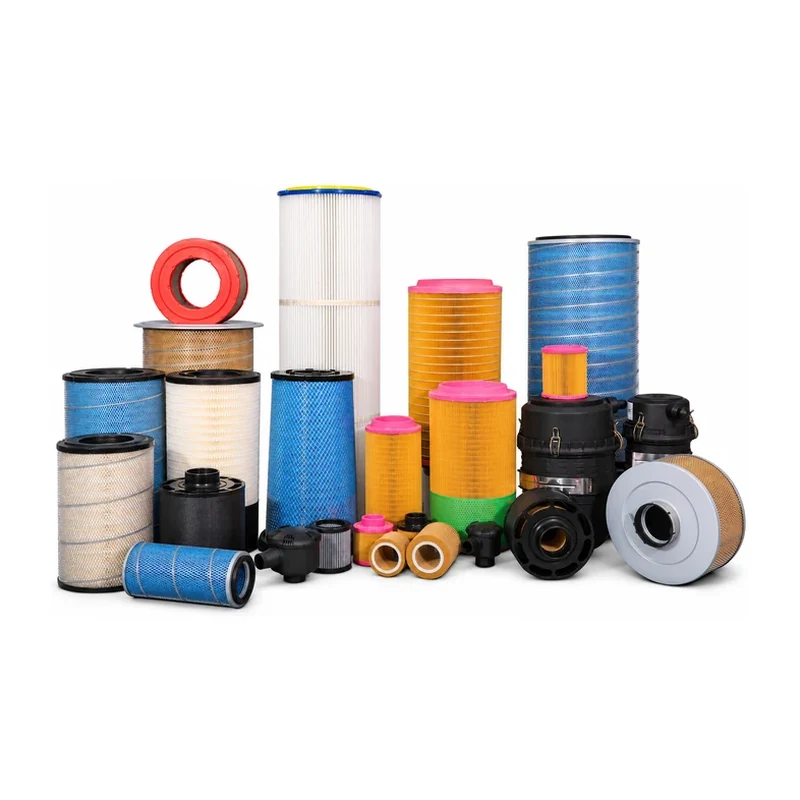
Record four dimensions and three materials before ordering: outer diameter, inner diameter, overall height, and the end-cap profile; then the media type, seal material and whether a safety element is used inside the main element. Iron-cap, PU, red-rubber and integrated designs all seat differently. Our air filter assemblies page groups housings by orientation, and the element range is split by end-cap construction so the sealing face matches the original.
When the housing, not the element, is the problem
If a new, correctly specified element shows dust on the clean side within a few hours, stop replacing filters and inspect the bowl. Cracks around the cover lugs, a bent seat, a missing drain valve or a corroded outlet stub cannot be fixed with a better cartridge. In high-dust applications, adding an air pre-cleaner upstream reduces the load on both the element and the seal and usually pays for itself in extended service intervals.
Frequently asked questions
What is a safety element and do I need one?
Can dust bypass happen if the restriction indicator reads normal?
Which end-cap type seals best?
Send the OEM number and machine model — we will confirm fit, media and seal before quoting.
Continue reading
Related products
View all products →Filter families referenced in this guide. Select a category to see specifications and available configurations.